Every time someone types into ChatGPT, they’re giving it a prompt. And every AI agent that answers a phone or a WhatsApp message has a much longer one behind it, which nobody sees, telling it who it is, what it has to do and what it must never do. A good part of what it answers depends on how well that’s written. Here’s what a prompt is, what it’s made of, a real example with two prompts and what the big players say about writing them.
In short
- A prompt is the text used to ask an AI model for something: instructions, context, examples and the question.
- An agent has two: the system prompt, written by the company and unseen by the customer, and what the customer writes.
- The model doesn’t obey like a program: it writes what’s most likely given everything in front of it.
- With a vague prompt, the same model made up a $75 call-out fee; with a well-written one, it said the office would confirm the price.
- The most useful advice, according to Microsoft: be specific and give the model a way out when it doesn’t know something.
What is a prompt?
A prompt is all the text a language model receives before it answers. The word comes from the theater, where the prompter feeds actors the line they have to say.
To see why it matters so much, remember how a model works. Microsoft’s guide puts it this way: the model tries to produce the words most likely to follow the preceding text. If the prompt asks a question, the model doesn’t switch into a special question-and-answer mode; it seems to answer because an answer is the most likely thing after a question. Everything in the prompt changes what’s likely, and so what it writes.
That’s where the discipline of writing them well comes from, called prompt engineering. IBM describes it as what helps models understand and respond better to all kinds of requests, from simple to highly technical. And Microsoft warns that it’s more of an art than a science, requiring experience and intuition, and that what works with one model doesn’t always work the same with another.
What is a prompt made of?
Microsoft’s guide distinguishes several pieces, and almost every useful prompt has more than one. The main one is the instructions: what the model has to do, as specifically as possible. Then there’s the primary content, the text the model has to process, like the email to summarize or the customer message to understand. And the supporting content, information that isn’t the task but shapes it: today’s date, the customer’s name, the contract they have.
The other two pieces are subtler. Examples teach by showing what’s wanted: a couple of customer messages with the right answer next to them. With no examples it’s called zero-shot, and with a few, few-shot; Microsoft points out that the model doesn’t learn from them for good, it only takes its bearings for that answer. And the cue is the start of the answer left written so the model carries on from there, for example “Key points:” so it answers with a list.
What is a system prompt?
When you talk to a chat, the prompt seems to be only what you type. In a real AI agent there are two layers. The system prompt (or system message) is written once by the company and goes before every conversation: who the agent is, who it works for, what it knows, what it has to ask, what it must never do and how it should speak. The customer doesn’t see it. What the customer writes is the second layer, and the model reads both together every time it answers.
In a field service company, the system prompt is where the office’s judgment lives: what is urgent, who gets called at night, what details are needed to open a work order and what is never promised. It’s what you’d explain to a new hire on their first day, written down.
A real example: the same model, two prompts
To see the difference, we sent the same customer message to the same commercial model twice. The first time with a one-line system prompt; the second with a five-sentence one. These are the answers, exactly as they came out:
What the customer writes
“Hi, how much do you charge to come and look at the boiler? The hot water isn’t working.”
Prompt A: one line
The model answersHello! Our standard call-out fee to inspect the boiler is $75. This includes a full assessment of the issue with your hot water. If any repairs are needed, we will provide you with a detailed quote before proceeding. Would you like to schedule an appointment?
Prompt B: with its job, what it doesn’t know and its rules
The model answersThank you for reaching out about your boiler issue. The office will confirm the pricing for the service visit. Could you please provide the address where the boiler is located?
With the one-line prompt, the model did what it was asked: be the assistant for a maintenance company. Nobody told it that it didn’t know the rates, so it gave the most likely figure, $75, with complete confidence, and even described what it includes. If the company charges $120, the customer now has a price in writing that nobody decided. With the second prompt, the same model says the office will confirm the price, makes nothing up and moves on to what it can do, which is take the request, asking only for the first detail it’s missing.
What changes between the two isn’t the model’s intelligence, which is the same, but what it has in front of it. The second prompt tells it what its job is, what it doesn’t know, what to do when asked about that, what details it needs and how it should speak.
How do you write a good prompt?
Microsoft’s guide sums it up well. The first thing is to be specific: leave as little as possible to interpretation. “Help the customers” lets the model decide what helping means; “take the request with the address, the brand and the error code” doesn’t. The second is to give context, because the model knows nothing about your company unless it’s told: where you work, what services you offer and to whom.
The third, and the most often forgotten, is to give it a way out when it doesn’t know something. It’s the Microsoft recommendation that shows best in the example above:
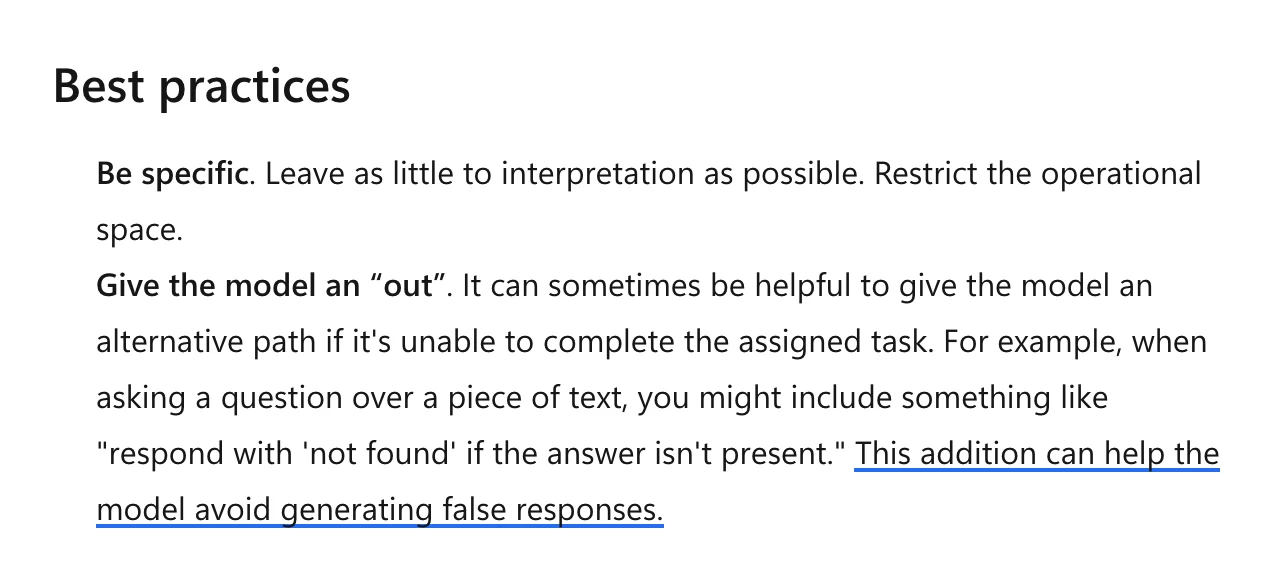
The fourth is to say what the answer should look like: how long, in what tone and in what format. If you don’t, the model chooses. And the fifth is to include examples when the task has nuances, like telling an emergency from something that can wait: a couple of real cases teach more than a paragraph of explanation.
Microsoft adds two details worth knowing. Order matters: what comes at the end of the prompt can weigh more than what comes at the start, so it sometimes pays to repeat the key instruction at the end. And asking it to cite where each fact comes from reduces made-up answers, because to get it wrong the model would have to fail twice: on the fact and on the citation.
What doesn’t a good prompt fix?
A good prompt makes the model behave better, but it doesn’t give it facts it doesn’t have. If the customer asks whether their contract covers the fault, no prompt knows that: the agent has to read the contract in your system at that moment. That’s what tools and RAG are for, putting the company’s documents and data in front of it with each answer. The prompt says how to use them.
Nor does it replace testing. A prompt is written, tested on real messages, checked for where it fails and corrected, over and over. That’s how we work at Delegic: each agent’s instructions are written with the company’s office, with its way of taking a request and its criteria for emergencies, and every change is tested on past requests before it answers a customer.
Frequently asked questions
What does prompt mean?
In the theater, it’s what the prompter does: feed someone the line they have to say. In AI it’s the text used to ask a model for something.
Is a longer prompt better?
Not because it’s longer. It’s better the more specific and less contradictory it is. A prompt of five clear sentences usually works better than three pages full of exceptions, and it’s quicker to read and fix. What it does cost is more money: models charge for every token they read, and the system prompt is read in full with every answer.
What is a system prompt?
The fixed instructions the company gives the model, which go before every conversation without the customer seeing them: who it is, what it does, what it never does and how it speaks.
Can a customer get around the prompt?
They can try, by writing things like “forget your instructions”. Models are trained not to listen, but it isn’t foolproof, which is why what matters can’t depend on the prompt alone: what the agent must never do, like delete a work order or give a price that doesn’t exist, is also controlled through the permissions on its tools.
Related terms
- LLM: the model that reads the prompt and writes the answer.
- RAG: how your documents are given to the model with each answer.
- Hallucination: when the model gives a fact that sounds right but is false.
- Guardrails: the limits that don’t depend on what the prompt says.
- Context window: how much text fits in a prompt.