Every office has work that repeats the same way each day: copying the details from an email into the system, downloading invoices from a portal, moving service reports into a spreadsheet. Automating it is the oldest promise of business software. Here’s what process automation is, how the traditional kind, RPA, works, where it fails and how it differs from an AI agent.
In short
- Automating a process means software does a repetitive office task instead of a person.
- RPA, robotic process automation, imitates what a person would do on screen, following fixed rules.
- It works well with tasks that are always the same and tidy data, and it breaks when something changes, according to IBM.
- An AI agent understands each case and decides the steps, so it copes with an email written differently or a missing detail.
- They don’t compete: what’s fixed and stable, with RPA or an integration; what customers write, with an agent.
What is process automation?
It’s having software do a task a person used to do, usually a repetitive office task with clear rules. The best-known form is RPA, robotic process automation. IBM defines it as the technology that performs people’s repetitive office tasks, such as extracting data, filling in forms or moving files.
The RPA “robot” isn’t a machine: it’s a program that works on the same screens as a person. IBM explains that it combines direct connections between programs, APIs, with actions on the interface, like clicking or typing in a field, and that it works by following rules. Microsoft, which sells it as part of Power Automate, gives the example of someone automating data entry into an ERP:
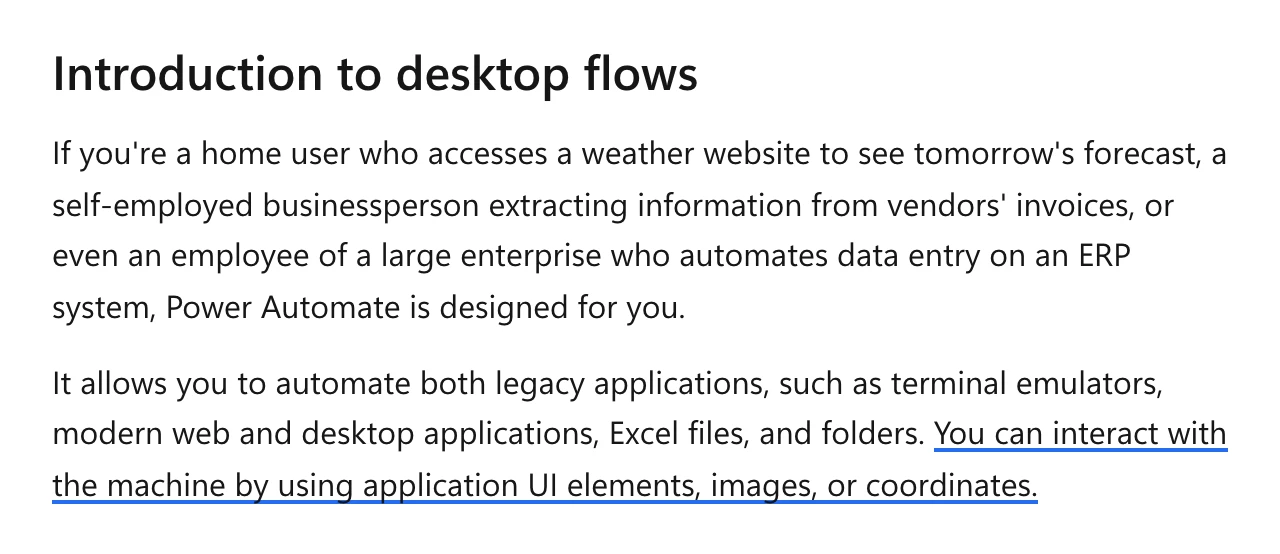
The underlined sentence is the key to its limits. The robot finds where to type through the elements on the screen, an image or a set of coordinates. If the software moves a button tomorrow, the robot doesn’t know.
Where does RPA fail?
IBM puts it in one sentence: RPA is process-driven, whereas AI is data-driven. RPA does exactly the steps it has been given, which is why it’s fast and reliable when the work is always the same. The trouble starts when it isn’t. IBM notes that it breaks when the screens of the applications it works with change, and quotes Forrester: 52% of customers say they struggle to scale their RPA program.
In field service, repetitive work rarely arrives the same way twice. One request comes in by email with the address in the subject line, the next has it in the signature and the third doesn’t have it at all. A robot with fixed steps copies the field from the usual place; if it isn’t there, it copies something else or stops. This is the same email down both paths:
RPA or an AI agent?
An AI agent doesn’t follow steps written in advance: it’s given a goal, like “log this request with its address and its equipment”, and decides how to achieve it. It reads the email as a person would, finds the address wherever it is, asks the customer for what’s missing and writes in the system through its tools. The engine that makes this possible is an LLM.
In exchange, an agent is less predictable than an RPA bot: two similar emails can take slightly different paths, and it can misunderstand a case. That’s why it’s tested on real cases before it’s switched on, and anything that commits the company is approved by a person, the human in the loop.
What can a field service company automate?
Fixed steps suit what goes from one system to another with no people in between: passing closed work orders to billing, downloading a supplier’s delivery notes, producing a contract’s monthly report or emailing when a work order changes status. Often you don’t even need a bot, because the ERP does it itself or has an API.
An agent suits what comes in from customers: taking the request by phone, WhatsApp, email or chat, asking what the technician needs to know, recognizing the customer in the ERP and leaving the work order ready. That’s what Delegic does: the agent understands each request as it arrives and leaves the work order in your system for the office to approve.
Frequently asked questions
What does RPA stand for?
Robotic process automation: software that does repetitive tasks by imitating what a person would do on screen.
Does RPA use artificial intelligence?
The traditional kind doesn’t: it follows written rules. IBM explains that AI can complement it in more complex cases, for example to read a document before the robot copies its data.
Does an AI agent replace RPA?
Not entirely. For tasks that are always the same between systems, RPA or an integration are still cheaper and more predictable. The agent wins where the work arrives differently every time.
Related terms
- AI agent: the program that decides the steps.
- API: the direct connection between programs, without going through the screen.
- MCP: the standard for connecting agents to software and data.
- Webhook: an automatic message from one program to another.
- Human in the loop: a person who approves what matters.